An Ifrikya FM production
Umuzi
The roots.
- Season 1 — September 2026
- One language per episode
- 15–20 min
- Five axes, scored in koris
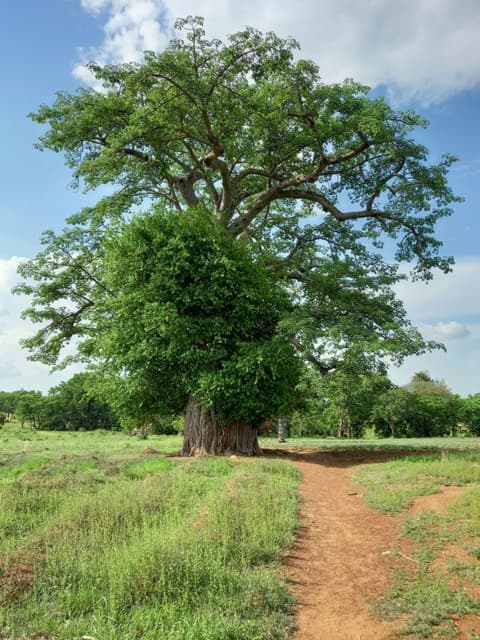
Umuzi is an Ifrikya FM production, launched by Moïse B. Selph and devoted to African languages: each episode explores one language as living heritage — its history, its reach, and what it tells us about the people who speak it.
A tree only stands by what cannot be seen: its roots. And the roots of Africa are its languages. Umuzi means “root” in Kinyarwanda — that is where the project takes its name.
The branches are our peoples. The roots are our languages.
The universe
A vast baobab, Muti, growing in Zamani.
The project imagines Africa as a vast baobab, Muti, growing in Zamani — “the time before,” where the roots of all our languages sleep. The tree’s branches are our peoples and cultures; but a tree only stands by what cannot be seen: its roots.
Scoring in koris
Five axes, scored in koris.
Each language is rated across five axes, scored in koris — the cowrie shells once used as currency. The more familiar and far-reaching a language, the more koris it gathers.
- Axe 1
Vitality
Speakers, transmission to children, official status, vitality.
/ 5 koris
- Axe 2
Reach
Geographic reach, lingua-franca role, diaspora.
/ 5 koris
- Axe 3
Crossroads · Influence
Contact, loanwords given and received.
/ 5 koris
- Axe 4
Written heritage
Script, ancient texts, literature.
/ 5 koris
- Axe 5
Modern presence
Digital, media, music, current creation.
/ 5 koris
The guest’s answers feed both the project and the koris verdict for each axis.
In koris
The languages scored so far.
No verdicts yet.
Every language covered will be scored here, axis by axis, as it comes out.
Season 1
Nine months, thirty-six languages.
The roadmap is public: thirty-six suggested languages, from the great trees to rare treasures, each with its family, region and ideal guest. It is also an open call: every language there is waiting for a voice.
How an episode runs
- 01The sound hook
- 02The identity card
- 03The story
- 04The treasures
- 05The koris verdict
Who I am looking for
Seven profiles, one requirement: to love a language.
Linguists and researchers
The eye that knows: classification, vitality, script, transmission. You are the first voice I am looking for — the one that gives the project its rigour.
Native speakers
Your language, your voice. Nobody can tell a language like the people who live it every day.
Writers and poets
What a language does to literature: proverbs, untranslatables, ancient texts and today’s creations.
Musicians and artists
Rumba, rap, the sounds of a market: a language also lives in music and in the street.
Teachers
Those who pass it on: in school, at home, in workshops. Vitality is decided in your classrooms.
Content creators
Keyboards, wikis, social media, AI: a language’s modern presence is built online, and you carry it.
Language revitalisation activists
You defend an endangered language, you document it, you wake it up. That is exactly the kind of fight the project wants to tell.
The season map
Thirty-six languages, each waiting for a voice.
Here is the season 1 roadmap, filterable by language or region. If one of these languages is yours — or the one you study — you have a place in that episode. And if it is missing, that is exactly what the form is for.
36 languages
Block 1 — The great trees· E1 – E9
E1
Swahili
Locuteur natif kényan/tanzanien
E2
Arabe (dialectal maghrébin)
Linguiste dialectologue
E3
Haoussa
Locuteur nigérian/nigérien
E4
Yoruba
Locuteur natif / musicien
E5
Amharique
Locuteur éthiopien
E6
Wolof
Locuteur sénégalais
E7
Zoulou
Locuteur sud-africain
E8
Lingala
Musicien / locuteur congolais
E9
Bilan : la grande famille bantoue
— (sans intervenant)
Block 2 — The crossroads· E10 – E18
E10
Bambara / Mandingue
Locuteur malien
E11
Peul (Fulfulde)
Locuteur peul
E12
Berbère / Tamazight
Linguiste / militant amazigh
E13
Somali
Locuteur somalien
E14
Kikongo
Linguiste
E15
Shona
Locuteur zimbabwéen
E16
Tigrinya
Locuteur érythréen
E17
Soninké
Locuteur natif
E18
Bilan : les langues d’emprunt
— (sans intervenant)
Block 3 — Rare treasures· E19 – E27
E19
Khoïsan (ex. !Xóõ)
Linguiste spécialiste
E20
Nubien
Linguiste / locuteur
E21
Dinka
Locuteur sud-soudanais
E22
Malgache
Locuteur malgache
E23
Éwé
Locuteur togolais/ghanéen
E24
Kanouri
Linguiste
E25
Sango
Locuteur centrafricain
E26
Oromo
Locuteur éthiopien
E27
Bilan : les langues menacées
— (sans intervenant)
Block 4 — Alive today· E28 – E36
E28
Nouchi (argot ivoirien)
Artiste / jeune locuteur
E29
Créole mauricien
Locuteur mauricien
E30
Afrikaans
Linguiste
E31
Pidgin nigérian
Créateur de contenu nigérian
E32
Comorien
Locuteur comorien
E33
Tswana
Locuteur botswanais
E34
Krio
Linguiste / locuteur
E35
Darija (libre / au choix)
Locuteur / artiste
E36
Bilan de saison : l’arbre entier
— (sans intervenant)
The languages listed are planning suggestions: nothing is set in stone. A linguist excited about a language missing from the map is a better reason to give it an episode than a checked box.
Your role
A remote interview of around 25–30 minutes.
Your contribution is a remote interview — video or phone — which I then edit to feature excerpts in the episode. The questions are sent in advance. You are credited, and the episode is shared on LinkedIn with a pan-African audience.
The form
Suggest a language, your voice, or someone else’s.
Four or five minutes is enough. The interview questions are sent to you in advance, and a proverb you love beats a CV.
Related essays